
- Overview
- Selection Committee
- Review
- Best Innovation Award
- Outstanding Innovation Award
- Encouragement Award
The Hitachi Global Foundation Asia Innovation Award is an award program launched in 2020 to promote science, technology and innovation that contributes to solving societal issues and realizing a sustainable society in the ASEAN region.
This award recognizes individuals and groups that undeniably served public interests through their outstanding achievements in research and development (R&D) in the fields of science and technology, including their visions of an ideal future society and social implementation plans for R&D as a means of achieving SDGs.
In fiscal year 2025, the Award invited submissions showcasing research and R&D achievements from 26 universities and research institutions across six ASEAN countries—Indonesia, Cambodia, Laos, Myanmar, the Philippines, and Vietnam. Applicants were required to select one goal and one target from among the 17 Sustainable Development Goals (SDGs) and 169 associated targets, and present work that contributes meaningfully to those objectives.
Applications were accepted through nominations from designated universities. Following a rigorous process comprising document screening, interviews and deliberation by the Selection Committee, 13 outstanding recipients were selected.
Presented below are the members of this year’s Selection Committee, the Chairperson’s review, and an introduction to the awardees’ research summaries and messages.
Selection Committee
Chair
Monte Cassim, Professor
President, Chair of the Board, Akita International University
Member
Yasuyuki Kono, Dr. Agri.
Vice-President for International Strategy, Kyoto University
Member
Yuri Sato, Dr.
Advisor to the President / Member of Executive Board, The Japan Foundation
Member
Yoshitaka Nishino, Dr. Eng.
Professor, Deputy Director
Headquarters for International Industry-University Collaboration, University of Tsukuba
Member
Eisaku MAEDA, Dr. Eng.
Dean and Professor, School of System Design and Technology, Tokyo Denki University
Review of The Hitachi Global Foundation Asia Innovation Award
Monte Cassim, Chairperson of the selection committee
The Hitachi Global Foundation Asia Innovation Award is an award program launched in 2020 to promote science, technology, and innovation that contributes to solving social issues and realizing a sustainable society in the ASEAN region. This award has been recognizing individuals and groups that undeniably served public interests through their outstanding achievements in research and development (R&D) in the fields of science and technology, including their visions of an ideal future society and social implementation plans for R&D as a means of achieving the United Nation's SDGs.
In its sixth year, the program revised the SDG selection method and evaluation criteria. Applicants can now freely select one SDG goal and one target they wish to contribute to through their research theme. Previously, applicants chose from two goals presented by the secretariat. This change has enabled more diverse proposals aligned with researchers’ expertise and interests. Furthermore, the evaluation criteria were streamlined from seven items to four:
- Relevance to Social Issues and R&D
- Utilization of Science and Technology, and Innovation
- Feasibility of the Social Implementation Plan
- Relevance to SDG Goals
The target countries remain the same: six ASEAN countries (Indonesia, Cambodia, Laos, Myanmar, the Philippines, and Vietnam), covering 26 universities and research institutions.
Overall, the proposals this year showed improved quality compared to last year. The freedom to choose SDGs attracted research from a wide range of fields, making the review process highly engaging. Distinct characteristics emerged by country, including research aimed at disseminating technology across ASEAN, innovations leveraging local resources and systems, product development and human resource training tailored to industrial structures, and other diverse initiatives. We hope to continue identifying forward-looking research that leads to social implementation.
From September to October 2025, the Selection Committee conducted a rigorous review, comprehensively evaluating application documents, academic papers, and online interviews, while considering differences in R&D capacity. As a result, we selected 13 awardees: one Best Innovation Award, four Outstanding Innovation Awards, and eight Encouragement Awards. With the approval of the President, a total prize amount of 11 million yen was granted.
We hope that this recognition will serve as a driving force to expand the impact of the awardees’ research in society.
Best Innovation Award

Target12.2
Geothermal Beyond Energy: Circular Mineral Recovery for Clean and Green Futures
Himawan Tri Bayu Murti Petrus
Professor
Chemical Engineering
Gadjah Mada University (UGM)
Republic of Indonesia
This video introduces the research overview of the Best Innovation Award recipient.
-
Research Title
Geothermal Beyond Energy; Circular Valorization of Geothermal Brine: Sustainable Recovery of Valuable Minerals for Clean Energy, Green Industry, and Advanced Material Applications
Social Issue
Geothermal energy is clean and renewable, but its operations produce underutilized mineral-rich brine waste that can harm ecosystems if mismanaged. Meanwhile, global demand for critical minerals like lithium, silica, and boron is rising, yet conventional mining causes environmental and social harm. Geopolitical concentration of mineral reserves also limits access for many geothermal-rich nations. This project offers sustainable solutions by recovering valuable minerals locally from geothermal waste, reducing environmental impact, strengthening supply chains, and promoting fair participation in the green economy. It empowers communities through training and shared benefits, fostering inclusive, resource-efficient development aligned with global sustainability goals.
Achievement of R&D
The project successfully developed and demonstrated high-value products and clean extraction technologies from geothermal brine, supporting sustainability, industrial innovation, and resource efficiency.
- Silica and nanosilica recovered through sol-gel and co-precipitation methods. With high purity and performance, they have been validated for applications in tires, green cement, and desiccants, and are currently ready for scale-up and field deployment. This contributes directly to reducing dependence on sand mining and enhances the circular use of geothermal waste.
- Boron compounds (e.g., boric acid, sodium borate) were extracted using pH-tuned adsorption and show strong potential for use in agriculture, ceramics, and high-tech glass. One of the product is embedded in the hydrogel for critical and marginal land plantation.
- Lithium carbonate (battery-grade) was produced via electro-nanofiltration and ion-sieve adsorption. While offering a promising low-impact alternative to conventional mining, lithium extraction remains in early pilot validation and is a key target for long-term deployment, particularly in energy storage and electric vehicle sectors.
Scientific and commercial outputs include:
- 10 patents, 18 international journal publications indexed by Scopus, and 10 international conference papers
- Market validation and commercialization readiness for silica and boron products
- Early-stage validation and continued industrial interest for lithium technologies
Strategically, the project:
- Convert geothermal plants into multi-resource platforms
- Reduces waste and improves resource efficiency
- Stimulates green jobs and local value chains
Offers a replicable model for geothermal-rich developing countries
Social Implementation
Stage:
The project has entered an early implementation phase, marked by pilot-scale trials and active community engagement.Key Activities and Outcomes:
- Pilot units at PT. Geo Dipa Energi (Dieng) enable on-site mineral recovery validation.
- Locals trained in brine handling and mineral processing through outreach programs.
- Early partnerships formed with SMEs to develop nanosilica and boron-based products.
- Community interest is growing, with proposals submitted for clean-tech microgrants.
- Implementation the nanosilica in many plantation area including karst, sandy, and post mining reclamation with several commodities including paddy, corn, coffee, horticulture, palm tree, fruit plantation (avocado, mango, etc.), sugar cane, and many more with positive impact such as productivity increase, passive prevention through insects, etc.
Roadmap (2025–2027):
- Complete feasibility study and initiate scale-up planning.
- Launch regional innovation hub with UGM and the stakeholders.
- Expand to other geothermal site not only Geodipa Dieng with decentralized units and training.
- Align activities with national policy on mineral recovery and circular economy.
Vision:
To transform geothermal plants into integrated hubs for clean energy, material recovery, and inclusive green economy development.Social Impact, Contribution to the SDGs
The project’s primary contribution is to SDG 12.2 by recovering lithium, silica, and boron from geothermal brine, converting waste into valuable materials, and reducing dependence on virgin mining. It also supports:
- SDG 9.4 - Sustainable industry:
Clean, modular recovery systems are integrated into geothermal plants to improve efficiency
→ Indicator: Volume of brine converted into usable products - SDG 13.1 - Climate action:
On-site mineral recovery avoids emissions and reduces water use compared to conventional mining
→ Indicator: CO₂-equivalent emissions avoided - SDG 8.5 - Decent work and economic growth:
Training programs and SME development promote green employment and inclusive economic opportunities
→ Indicator: Number of participants trained and SMEs engaged - SDG 11 - Sustainable communities:
Collaboration with local farmer groups enables community-based innovation and adoption
→ Indicator: Uptake of silica and hydrogel in farming practices
Activities

Implementation of nano silica in paddy’s plantation (harvesting period), I am the one in the right hand side using green shirt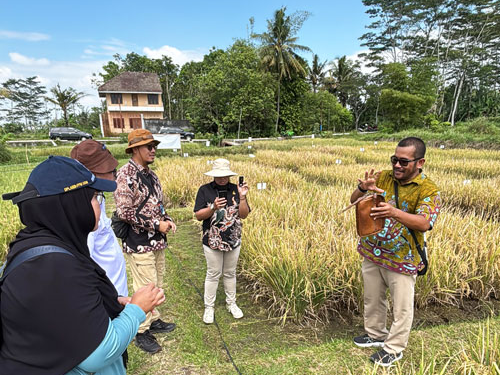
Explaining to Agrinas Palma members on nano silica implementation in the paddy’s plantation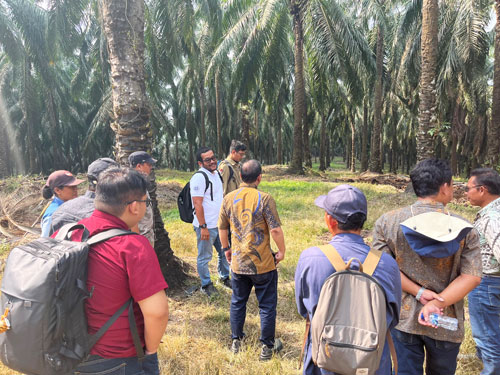
Providing some information to people working in the palm plantationMessage from Awardee
Curiosity will never kill us is the courageous that I must nurture my research and development journey. Being passionate and impactful is the spirit to clarify the final objective at where the research result will be implemented.
Outstanding Innovation Award

Target6.3
From Pollutants to Protein: Sustainable Bioremediation for Health and Food
Adi Setyo Purnomo
Professor
Head of Fundamental Science Research Center ITS
Directorate of Research and Community Services
Laboratory of Microbial Chemistry, Department of Chemistry,
Faculty of Science and Data Analytics
Sepuluh Nopember Institute of Technology (ITS)
Republic of Indonesia
-
Research Title
From Pollutants to Protein: Novel Eco-Bioremediation Beads for Environmental Health and Food Security
Social Issue
Industrial batik dye waste has become an invisible crisis in rural Indonesia, poisoning waterways, exhausting soil, and placing entire communities at risk. Public health, agriculture, and traditional livelihoods suffer simultaneously, turning what was once cultural heritage into an environmental and socio-economic burden.
Achievement of R&D
The synergy of a high-performance bacterial bio-composite and TiO2 photocatalysis creates a breakthrough solution for turning toxic batik wastewater into clean, safe water. This solar-powered reactor achieves over 90% decolorization while running completely off-grid, reducing treatment costs by up to 50%. Its modular and intuitive design makes advanced clean technology accessible even for small-scale artisans. The treated water and captured waste are further converted into mushroom growth substrates, adding new economic value for rural communities. By transforming pollution control into opportunity and resilience, this innovation sets a new benchmark for decentralized water treatment and marks an important step toward a more sustainable and inclusive industrial future.
Social Implementation
Implementation in rural East Java extends beyond installing technology; it begins with understanding the daily realities of artisans whose livelihoods depend on clean water and sustainable production. The system is co-designed to align with their workflows, cultural practices, and local constraints. After installation, continuous mentoring builds confidence so artisans can independently operate, troubleshoot, and maintain the solar reactors. The approach expands community ownership, strengthens technical and environmental literacy, and creates long-term stability. Cleaner rivers, healthier living spaces, and more resilient rural industries stand as tangible results, showing how accessible innovation can restore dignity, safety, and economic opportunity for village-based batik communities.
Social Impact, Contribution to the SDGs
This initiative drives SDGs 6, 9, 12, and 15 while supporting SDGs 3, 5, 7, 10, 13 by restoring water quality, reducing toxic pollution, enhancing gender-inclusive industry, strengthening rural resilience, and expanding clean-tech solutions powered by renewable energy.
Activities
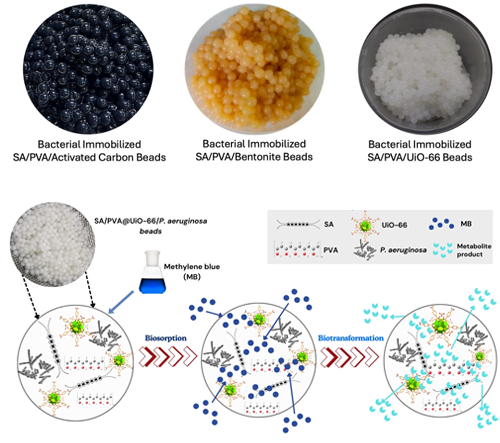 Mechanism of biosorption and biotransformation in MB decolorization
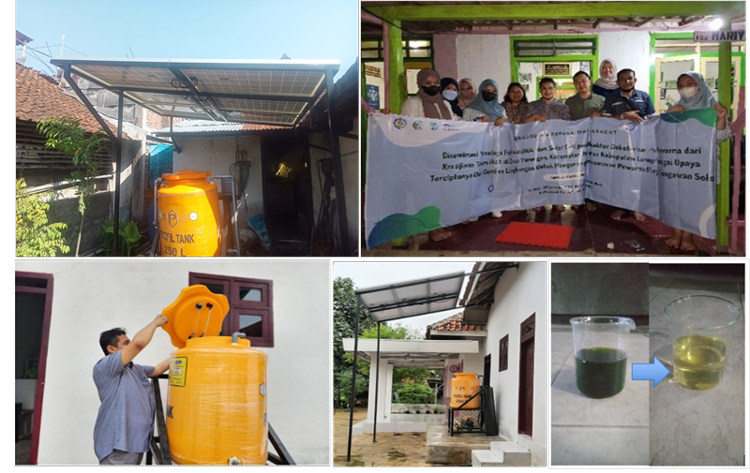 Installed Solar Bioreactor in rural East Java, Indonesia
Message from Awardee
Innovation finds its true meaning when it touches the lives of those most affected by environmental harm. When science listens to community wisdom, solutions grow that protect health, heal ecosystems, and create sustainable futures—progress that includes everyone and lasts for generations.
Outstanding Innovation Award

Target9.1
Thermomechanical and Computational Design for Reliable Semiconductor Packaging
Aristotle Tulagan Ubando
Full Professor and Assistant Dean for Research and Advanced Studies
Department of Mechanical Engineering
Gokongwei College of Engineering
De La Salle University (DLSU)
Republic of the Philippines
-
Research Title
Thermomechanical Analysis and High Computational Design for Semiconductor and Electronics Packaging Reliability
Social Issue
The Philippine semiconductor and electronics manufacturing sector, which is a key export driver, lacks domestic high-value R&D capability. The industry relies on costly, slow experimental methods for product design. This then hinders local innovation, limits the adoption of sustainability practices, and restricts the development of a highly skilled engineering workforce in the country.
Achievement of R&D
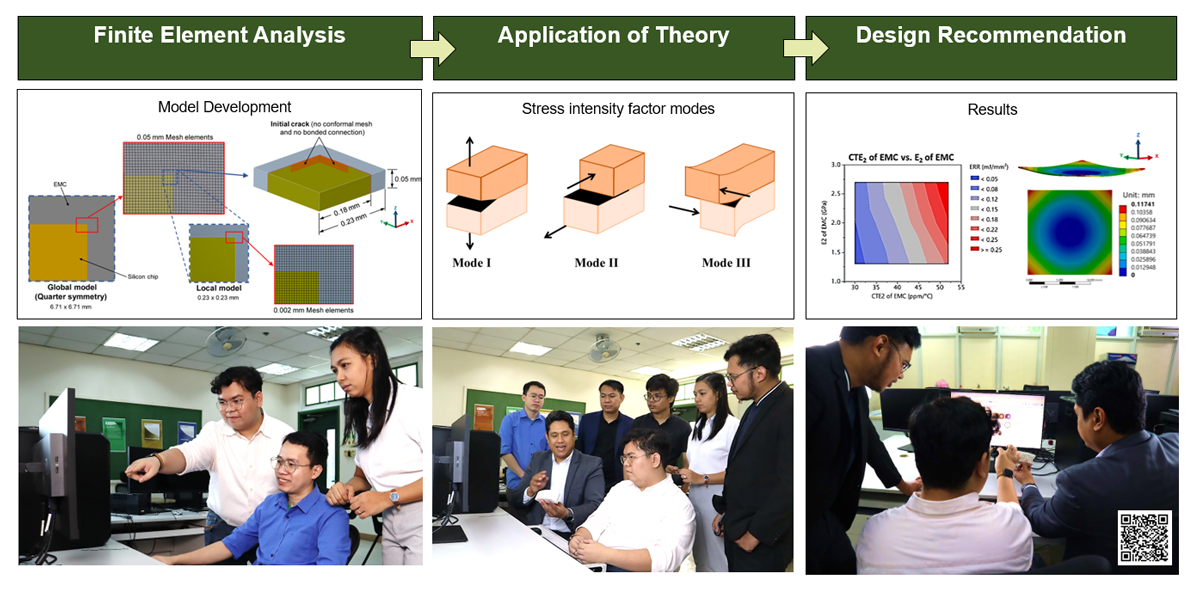
The Thermomechanical Analysis Laboratory (TALa) was established through government support and a successful collaboration model with semiconductor companies in the Philippines. TALa delivers computational, Finite Element Analysis (FEA) solutions that virtually evaluate electronic packages' material behavior under thermal and mechanical stress. This R&D provides a cost-efficient alternative to traditional experimental testing, significantly saving on the cost and time associated with physical prototyping. This enables rapid design optimization, preventing product failures, and ultimately raising the quality of Philippine-made electronic packages. TALa also develops highly skilled engineers, providing valuable R&D career opportunities within the country.
Social Implementation
TALa is located at the DLSU Laguna Campus (close proximity with Laguna Technopark Inc.), operates as a computational design resource for semiconductor companies. This industry-academe model ensures that academic research directly addresses critical industrial needs, such as yield improvement and next-generation product R&D. Through government- and industry-funded projects, high-performance supercomputers were acquired, providing essential, accessible computational infrastructure to industry partners. This immersive program trains highly skilled students and faculty, successfully transitioning the local sector toward high-value, self-reliant design and innovation.
Social Impact, Contribution to the SDGs
SDG 9 is directly addressed by TALa which is the Industry, Innovation, and Infrastructure. Specifically Target 9.5 by significantly enhancing domestic scientific R&D capacity and encouraging innovation in the electronics sector. TALa ensures the development of a highly specialized engineering workforce.
Activities
Message from Awardee
Our work at TALa proves that when universities, government, and local companies work together, we can create robust and innovative electronic packaging designs. This R&D innovation engages both students and faculty in solving real-world industry problems. This solution transforms our nation by strengthening our economy, and creating high-level jobs for the next generation of Filipino engineers.
Outstanding Innovation Award
Target11.6
Smart Gas Sensor for Early Detection of Toxic Gases to Protect Health and Environment
Manh Hung Chu
Associate Professor
Department of Electronic Materials and Devices; School of Materials Science and Engineering
Hanoi University of Science and Technology (HUST)
Socialist Republic of Viet Nam
-
Research Title
Smart Gas Sensor Development for Early Warning of Toxic and Harmful Gases to Protect Health and the Environment
Social Issue
Urbanization, rapid industrialization and transportation in big cities have resulted in higher emissions of toxic and harmful gases (e.g. NO2, CO, HC, H2S, etc.), which result in air pollution and health risks. Thus, it is urgent to develop smart sensor systems for real-time gas monitoring and early air pollution warning.
Achievement of R&D
The R&D successfully developed low-power gas sensors using advanced nanomaterials — Including doped/decorated semiconductor metal oxides (SMOs) and transition metal dichalcogenides (TMDs; e.g. MoS2, WS2, and SnS2, etc.) — enabling high sensitivity, selectivity, and fast response to multiple toxic gases at ppm & sub-ppm levels at low or room temperature. The sensor devices were integrated into compact prototypes with wireless communication modules and used AI/ML algorithms for multi-gas classification and real-time analysis. Apart from products, our work resulted in 90+ publications; five patents; multiple national and international projects, and a State Prize for Science and Technology, demonstrating strong scientific, technological, and social impact.
Social Implementation
The R&D will be implemented through phased deployment. Currently, the social implementation of this R&D is at early stages: i) successful fabrication of gas sensors based on advanced sensing materials with highly sensitivity, selectivity, stability to different toxic gases at low temperature; ii) Optimizing the integration of sensor devices into a prototype product; development of preliminary IoT-based data acquisition and processing modules, including basic software for real-time data display. Later phases will focus on finalizing prototypes, raising public awareness, piloting systems in big cities and industrial zones in Vietnam, large-scale deployment, and technology transfer to local industry.
Social Impact, Contribution to the SDGs
The achievement and the social implementation of the proposed R&D project directly contribute to SDG Goal 11 and Target 11.6, which aims to reduce negative impact (increasing harmful/toxic gas emission) of urbanization, rapid industrialization to air environment and human health by real-time air pollution monitoring and early air pollution warning.
Activities
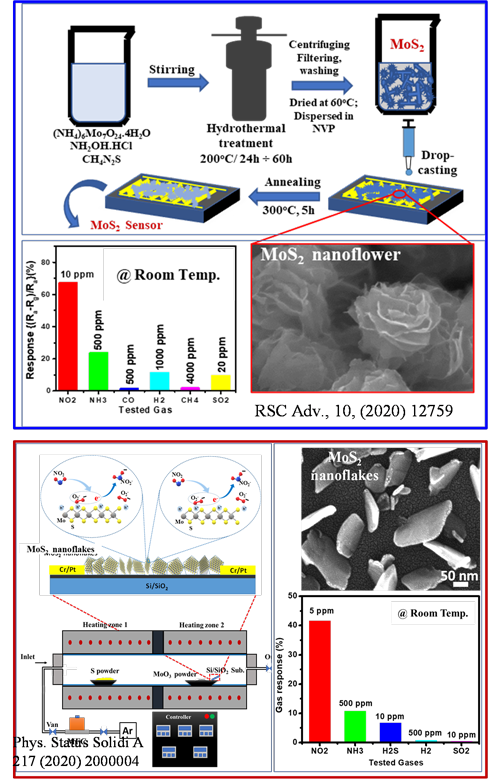
Representative RT NO2 sensor chips based on MoS2 nanoflowers and nanoflakes grown by hydrothermal (top) and CVD (bottom) methods.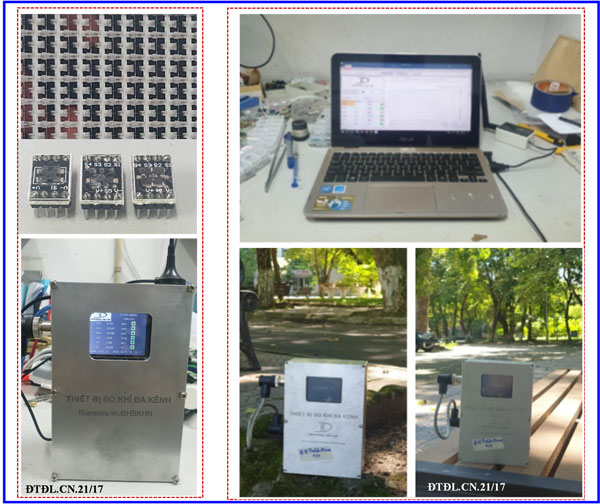
Sensor chips fabricated on wafer and after housing on PCB (Top-left). Representative multi-gas channel station for wireless monitoring and Hand-held gas detector (Bottom-left). Testing of LoRa signal transmission and collection of a multi-gas channel station (Right)Message from Awardee
I am deeply honored to receive this Outstanding Innovation Award. My sincere thanks to the Hitachi Global Foundation, my research group, and all collaborators. This recognition strengthens our commitment to advancing smart gas-sensing technologies and delivering impactful scientific innovation for healthier, safer, and more sustainable communities.
Outstanding Innovation Award

Target9.5
Quantum and AI Optimization for IC Design: Accelerating Semiconductor R&D in Vietnam and Beyond
Trang Hoang
Associate Professor
Electronics Engineering
Ho Chi Minh City University of Technology (HCMUT)
Socialist Republic of Viet Nam
-
Research Title
Quantum- and AI-Powered Optimization for IC Design: Accelerating Semiconductor R&D in Developing Countries such as Vietnam
Social Issue
Vietnam, as a developing Country, faces a significant gap in semiconductor R&D due to limited infrastructure, expensive design tools, and a shortage of skilled engineers, hindering innovation and digital transformation. This technological divide restricts participation in the global value chain and limits economic opportunities in high-tech industries.
Achievement of R&D
This research developed a novel AI- and quantum-powered optimization platform for analog integrated circuit (IC) design, addressing cost, complexity, and accessibility barriers in semiconductor R&D. By enhancing meta-heuristic algorithms and integrating them with professional simulation tools, the solution reduces design time, improves energy efficiency, and enables scalable IC development. With a U.S. patent granted and successful pilot deployment in academia, this platform empowers students, startups, and researchers in developing countries to engage in advanced analog design, even with limited resources—supporting inclusive innovation and digital transformation in Vietnam and beyond.
Social Implementation
The platform is being integrated into university curricula, especially at HCMUT—Vietnam’s leading engineering school—and is being transferred to IC design startups and research labs through collaborative projects. Train-the-trainer workshops, seminars, and webinars are being held to support capacity building. Licensing opportunities are underway with domestic and regional fabless firms. Open-access components and academic–industry workshops promote widespread adoption. The platform is already piloted in graduate programs and has trained multiple Ph.D., Master’s, and undergraduate students. These efforts contribute to building a sustainable semiconductor innovation ecosystem in Vietnam, fostering self-reliance in high-impact R&D sectors.
Social Impact, Contribution to the SDGs
The platform advances SDG 9.5 by democratizing access to IC design, empowering engineers, accelerating innovation, and strengthening R&D infrastructure in developing countries. It bridges the global technology gap while promoting inclusive, sustainable growth in the semiconductor sector.
Activities
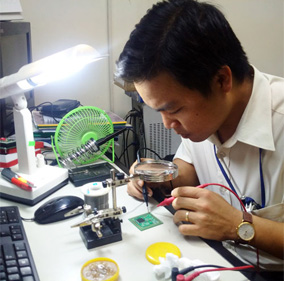
My R&D in lab: testing my chip after design and fabrication (2014)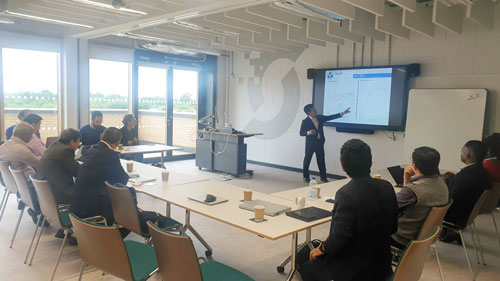
Sharing my research, at University of York, UK (2024)Message from Awardee
As a university lecturer, I believe science must serve society. My mission is to develop inclusive, accessible technologies that empower people—especially in developing countries. Through education and innovation, I aim to nurture the next generation of engineers who will lead sustainable change for their communities.
Encouragement Award

Target2.3
From Full-Fat Soybeans to Alternative Meat: Sustainable Protein through Single-Screw Extrusion and Local Partnerships
Floirendo Pantas Flores
Professor
Institute of Food Science and Technology
University of the Philippines Los Banos (UPLB)
Republic of the Philippines
-
Research Title
Innovative Protein Sustainability Through Processing of Full-Fat Soybeans into Alternative Meat via Single-Screw Extrusion: Partnering with Government and Agricultural Cooperative in Cagayan Valley
Summary
Soybean farmers in the Philippines miss out on revenue when soybean is processed into high-value alternative meat because the existing technology is expensive. The country imports both soybean and textured soy to obtain the associated health benefits of these. Thus, there is an economic opportunity for helping the farmers and cooperatives to generate employment for indigenous peoples, women, and out-of-school youths, and contribute to sustainable agriculture. We developed a cost-effective single-screw extrusion process that eliminates chemical wastes and generates alternative meat. The full-fat process results in a nutritious product with a high protein content and a shelf-life of 6 months. The technology has already been adopted by the Department of Agriculture Cagayan Valley Research Center. The product can be sold as is or as local and regional dishes by the agricultural cooperative. Our collaborative efforts can help meet UN SDG 3.2 and double the agricultural productivity of small-scale food producers.
Encouragement Award

Target12.2
Development of Organic Fertilizer and Biochar Using Agricultural Wastes and Aquatic Plants
Hoa Thi Thai Hoang
Professor
Department of Crop Science, Faculty of Agronomy
University of Agriculture and Forestry, Hue University (HU)
Socialist Republic of Viet Nam
-
Research Title
Research and Development of Organic Fertilizer and Biochar Products from Agricultural Wastes and Aquatic Plants for Sustainable Crop Production
Summary
Overuse of chemical fertilizers and pesticides in Vietnam has also led to undesirable environmental consequences. As a solution, successful production of different organic fertilizers and biochar products from agricultural wastes and aquatic plants, along with testing their effectiveness on different crops in Hue City, has been carried out.
The research has benefited farmers, local communities, extension agencies, researchers, and private companies. The overall impact of widespread adoption of improved techniques is expected to include a reduction in environmental pollution caused by waste from animal raising, agriculture, and water hyacinth, such as reducing chemical fertilizer use and nutrient leaching to groundwater, increasing crop yield and quality, and improving soil fertility and community health.
The use of organic fertilizer and biochar from agricultural wastes and aquatic plants directly supports SDG Goal 12 (Ensure sustainable consumption and production patterns), particularly Target 12.2 (Achieve sustainable management and efficient use of natural resources).
Encouragement Award

Target2.4
Enhancing Rice Productivity and Promoting Sustainable Agriculture through Beneficial Microbes
Kakada Oeum
Researcher
Research and Innovation Center
Institute of Technology of Cambodia (ITC)
Kingdom of Cambodia
-
Research Title
Utilizing Beneficial Microbes (Bacteria and Fungi) as Biofertilizers and Biopesticides to Enhance Rice Productivity and Promoting Sustainable Agriculture
Summary
Rice farmers in Cambodia face many challenges, including poor soil quality, frequent pest and disease outbreaks, and health risks from the overuse of agrochemical products such as fertilizers and pesticides. My research offers a simple, natural solution by using beneficial microbes like bacteria and fungi from local rice fields to make biofertilizers and biopesticides. These tiny helpers can improve soil health, protect plants from disease, and increase rice yields without harming the environment. Together with local farmers, NGOs, and government partners, we are testing and promoting these natural products in real rice fields. Farmers are trained to use them safely and effectively. This project helps reduce chemical use, lowers costs, and supports healthier and more sustainable farming. It also contributes to the United Nations’ Sustainable Development Goal 2: Zero Hunger, by improving food security, protecting nature, and supporting better lives for rural communities.
Encouragement Award

Target9.5
Sustainable Manufacturing of Functional Nanomaterial-Based Sensors for Energy, Health, and Environmental Monitoring
Ruri Agung Wahyuono
Assistant Professor
Engineering Physics
Sepuluh Nopember Institute of Technology (ITS)
Republic of Indonesia
-
Research Title
Sustainable Manufacturing of Functional Nanomaterials-based Sensors for Energy, Health, and Environmental Monitoring
Summary
Indonesia faces persistent challenges in healthcare accessibility, food authentication, and environmental and energy monitoring, compounded by dependence on imported and costly sensor devices. Our R&D initiative introduces sustainable, multifunctional, and IoT-integrated biosensors fabricated from locally sourced nanocellulose paper, promoting low-cost and eco-friendly production. Developed prototypes include MediVeal for early neurological disorder detection, Co-Detector for Chronic Obstructive Pulmonary Disease diagnosis, LardDetect for Halal verification, and pentachromatic spectrometer for organic and inorganic pollutant sensing. These systems are portable, field-ready, and tailored for tropical and rural conditions.
Social implementation focuses on deploying biosensors in village clinics and schools, and Halal testing kits for micro and small food enterprises, supported by local training. The project primarily advances SDG 9 (Industry, Innovation, and Infrastructure) through sustainable manufacturing and local technology creation. It further supports SDGs 3.d, 3.9, 6.3, 6.a, 7.b, 8.2, and 8.3 by enabling accessible technology, resilient infrastructure, and community empowerment for sustainable development.
Encouragement Award

Target2.4
Utilizing Rice Distiller By-Products to Improve Productivity and Reduce Environmental Impact of Local Cattle in Lao PDR
Sangkhom Khom Inthapanya
Associate Professor, Dr.
Animal Science
Souphanouvong University (SU)
Lao People's Democratic Republic
-
Research Title
Rice Distiller as an Alternative By-Product for Increasing Performance and Methane Production Mitigation of Local Yellow Cattle in Lao PDR
Summary
This research tackles key social issues in Lao PDR by introducing rice distiller by-products as a cost-effective feed to boost the performance of local cattle while lowering methane emissions. This innovative R&D research has supported rural livelihoods through affordable feeding options, enhanced food security by reducing competition between food and feed resources, and contributed to climate change mitigation. It also encourages sustainable waste management, equitable access to innovation, and cultural acceptance of improved feeding practices. Our implementation involves farmer training programs based on the feeding guidelines incorporating rice distiller by-products, cassava foliage, and demonstration farms to show practical benefits. This research initiative creates positive social impact by improving productivity, cutting emissions, and strengthening rural incomes. The solution contributes to several Sustainable Development Goals (SDGs), including SDG 1 (no poverty), SDG 2 (zero hunger), SDG 12 (responsible consumption and production), and SDG 13 (climate action).
Encouragement Award

Target12.4
Graphene-Based Nanomaterials Synthesized from Steelmaking Waste for Advanced Environmental and Industrial Applications
Tan Thi Vu
Doctor
Group Inorganic Technology and Fertilizer, Department of Chemical Engineering
Hanoi University of Science and Technology (HUST)
Socialist Republic of Viet Nam
-
Research Title
Sustainable Graphene-Based Nanomaterials Synthesized from Industrial Waste, Promoting Circular Economy, Minimizing Environmental Impact, and Enabling Advanced Environmental and Industrial Applications
Summary
Social Issue: Vietnam’s rapid industrial growth puts pressure on resources and creates waste and pollution.
Our Solution (R&D): We take waste from steelmaking—kish graphite and electrode scrap—and turn it into graphene, an ultra-thin, strong carbon material. We use green, scalable methods. So far we have 17 international patents and peer-reviewed papers. The graphene works in water cleaning, CO₂ capture, energy devices, and coatings that prevent rust.
Social Implementation: We are testing with industry partners, preparing licenses, and planning a pilot production line to check cost, safety rules, and performance in real factories.
Social Impact / SDGs: This work supports SDG 12.4. It turns hazardous waste into useful products, saves natural resources, and cuts harmful chemicals. It also makes longer-lasting materials and membranes, so less waste is produced. Overall, it helps Vietnam move toward cleaner, more circular, innovation-driven industry.
Encouragement Award

Target3.b
Development of Advanced Immuno-Nanomedicine and Vaccine Platforms to Improve Public Health
Viet Quoc Le
Vice Dean, Head of Department
Department of Pharmaceutical Technology and Pharmacy Administration, Faculty of Pharmacy
Ton Duc Thang University (TDTU)
Socialist Republic of Viet Nam
-
Research Title
Development of advanced immuno-nanomedicine and vaccine platforms targeting major diseases to improve public health
Summary
Many developing countries continue to face serious healthcare challenges, including limited access to affordable medicines and vaccines, particularly in rural areas. Infectious diseases such as dengue and COVID-19, along with chronic illnesses like cancer, place a heavy burden on healthcare systems. Moreover, many existing medicines are still constrained by adverse effects and toxicity.
To help address these issues, my team and I have developed new types of safe, fine-tuned materials, which we called nanoplatforms that can deliver medicines and vaccines more effectively. For example, we created polydopamine nanoparticles that enhance cancer treatment with light irradiation, peptide-based nano carriers that boost vaccine responses and advanced biomaterial-inspired drug delivery systems that improved treatment outcome. These systems have shown very promising results in laboratory studies and have been reported in top-tier scientific journals.
Although our research is still at the preclinical stage, it shows strong potential for future translation into practical applications. We aim to collaborate with biotech companies in Vietnam and ASEAN to advance this work. In the long term, by training young researchers in nanomedicine, we hope to contribute to UN Sustainable Development Goal 3 (Good Health and Well-being) by improving future access to affordable, locally produced nanomedicines.
Encouragement Award

Target3.4
Green Analytical Methods for Rapid Assessment of Food Safety, Authenticity, and Functional Quality in Diverse Food Systems
Widiastuti Setyaningsih
Associate Professor
Department of Food and Agricultural Product Technology
Gadjah Mada University (UGM)
Republic of Indonesia
-
Research Title
Green Analytical Methods for Rapid Assessment of Food Safety, Authenticity, and Functional Quality in Diverse Food Systems
Summary
Many laboratories and food producers in Southeast Asia still rely on time-consuming, single-target testing methods, limiting the ability to ensure food safety and unlock the value of local functional ingredients. My research addresses this issue by developing green, multi-target analytical methods that allow rapid, simultaneous analysis of food additives, contaminants, and functional compounds—reducing testing time from days to minutes.
These methods have been adopted by national regulators (Indonesian FDA, Customs, law enforcement) and industry partners, including SMEs, for real-time surveillance and product development. They also enable profiling of natural bioactive compounds, such as antidepressants in banana flower and antioxidants in a wide range of edible flowers.
An open-access web platform expands global access to cocoa and macroalgae authentication. This research contributes to SDG 3.4 by supporting preventive health and food innovation through scalable tools that empower regulators, industries, and communities in promoting safe and functional food systems.
Contact
The Hitachi Global Foundation
Office of The Hitachi Global Foundation Asia Innovation Award